


Leonids 2026: When and How to Watch the November Fireballs & Night-Sky Photography Guide

Past midnight in mid-November, as the Sickle of Leo climbs above the eastern horizon, skywatchers naturally recall the historic nights of 1833 and 1966 when thousands of shooting stars crossed the sky every hour.
As Earth approaches the orbital dust streams left behind by Comet 55P/Tempel-Tuttle each autumn, what kind of observing window awaits us on the night of November 17–18, 2026, and when does the sky become truly dark for observers and astrophotographers?

When and What Time to Watch: Peak Hours and Moonset Window
According to the International Meteor Organization (IMO), NASA, and the American Meteor Society (AMS), the Leonid meteor shower is active from November 6 to November 30, 2026. While some general sky calendars list the night of November 16–17, orbital dust-trail models point to the night of November 17–18 as the primary observing window, making both nights worth monitoring:
Primary Nodal Peak & Secondary Trail: IMO modeling places Earth's passage through the main orbital node on Tuesday, November 17, 2026 at 23:45 UTC (Wednesday, November 18 at 02:45 TRT), while Mikhail Maslov models a weak secondary dust encounter on Tuesday, November 17 at 16:00 UTC.
First Quarter Moonset: U.S. Naval Observatory (USNO) lunar data indicates that the ~50% illuminated First Quarter Moon sets at approximately 00:45 TRT on Wednesday, November 18 for Istanbul (exact moonset timing varies by a few minutes depending on your city, longitude, and local horizon elevation).
Best Dark-Sky Window: Once the Moon drops below the western horizon around 00:45 TRT, the sky remains completely dark until astronomical dawn near 05:30 TRT, providing nearly five uninterrupted hours of optimal viewing.
Where to Look with the Naked Eye and Cold-Weather Field Preparation
You do not need a telescope or binoculars to watch the Leonids; their narrow field of view restricts you to a tiny patch of sky and causes you to miss fast-moving streaks. Your naked eyes are the best instrument. After midnight, as the constellation Leo rises in the east-northeast, avoid staring straight at the radiant. Looking 30°–45° away from Leo—toward Ursa Major, Gemini, or high overhead—uses perspective to reveal longer meteor trails. Give your eyes 20–30 minutes away from phone screens and white flashlights to reach full dark adaptation.
Mid-November nights drop near or below freezing at rural dark-sky sites. Because meteor observing involves lying still for hours, bring a reclining lawn chair or insulated ground pad, a winter sleeping bag, thermal base layers, a windproof outer shell, a thermos of hot tea or coffee, and a red-light headlamp to preserve your night vision while checking gear.

Photographing Leonid Fireballs: Smartphone vs Camera Exposure Settings
Standard smartphone Night Mode algorithms combine multiple short exposures and frequently erase transient single-frame meteor streaks as sensor noise. While a phone mounted on a tripod in Pro/Manual RAW mode can occasionally catch a brilliant fireball, consistent astrophotography requires a DSLR or mirrorless camera with manual exposure control:
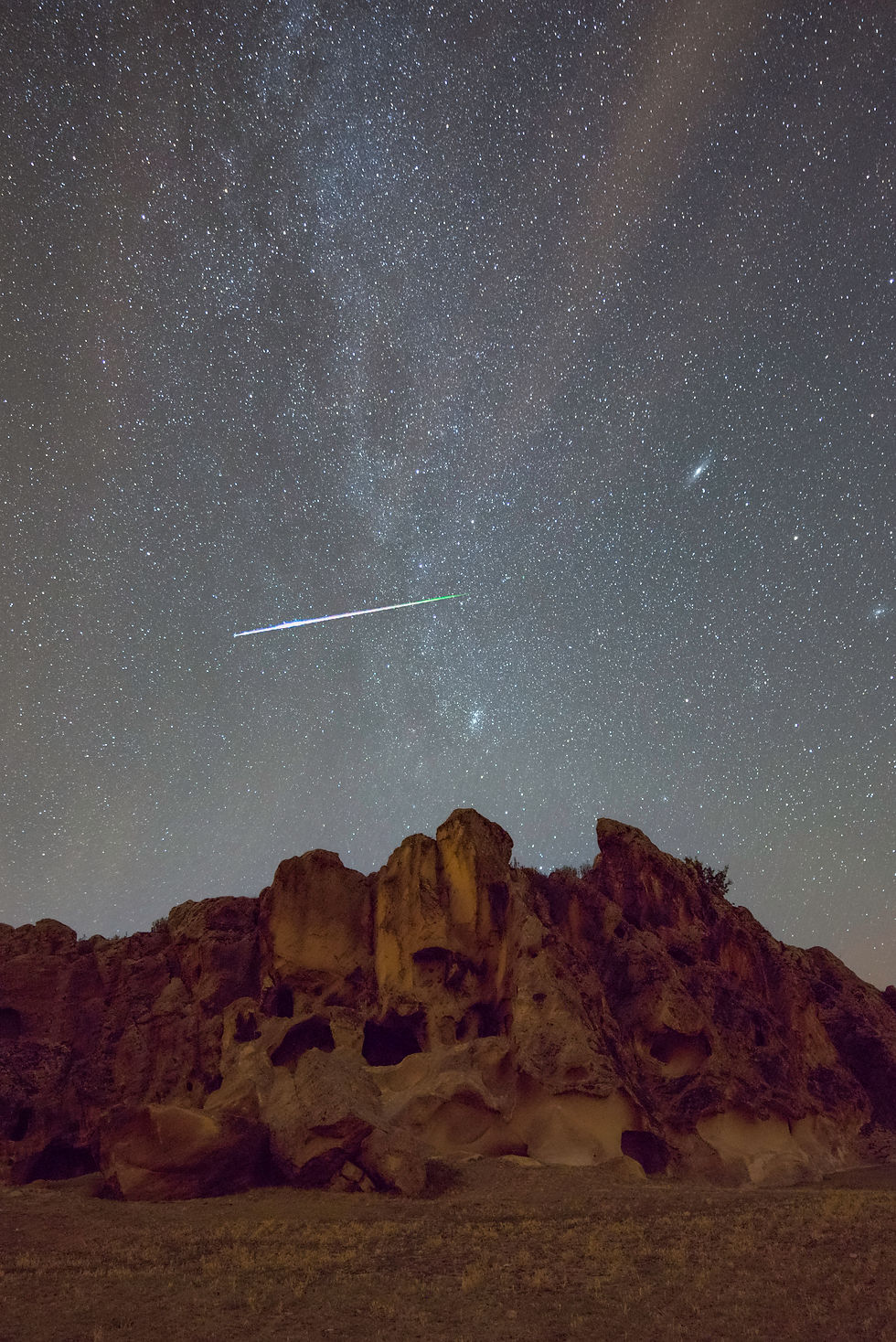
Fast Wide-Angle Lens & Tripod: Mount a 14–24 mm f/1.4–f/2.8 wide-angle lens on a sturdy tripod, frame the sky 30°–45° away from Leo with an appealing landscape foreground, and wrap a USB dew heater strap around the lens barrel to prevent frost.
Precision Manual Focus: Disengage autofocus, switch on Live View, and magnify a bright star such as Regulus or Sirius by 5x–10x to lock pinpoint manual focus.
RAW Format & Noise Reduction Off: Record uncompressed RAW files to preserve dynamic range in green ionization trails, and turn off Long Exposure Noise Reduction so the camera never pauses for dark frames between shots.
Shutter Speed & ISO: Set your shutter speed to 8–15 seconds at f/1.4–f/2.8 and choose ISO 1600–3200 to record faint meteor streaks without overexposing star colors.
Continuous Interval Shooting: Connect an external or built-in intervalometer with a 1-second pause between frames and shoot continuously from moonset until dawn.

The Tempel-Tuttle Cycle, Realistic 2026 Expectations, and Next Steps
The parent body of the Leonids, Comet 55P/Tempel-Tuttle, completes one orbit around the Sun every 33.2 years and produced the historic meteor storms of 1833, 1966, and 1999–2002. That 33.2-year period belongs to the comet's orbit rather than an automatic storm schedule; because Jupiter's gravity deflects old dust trails, even around the 2035 cycle a meteor storm is not guaranteed. Because Earth passes outside the dense storm filaments this year, no Leonid meteor storm is expected in 2026.
Even without a storm, Leonid meteoroids strike Earth's upper atmosphere head-on at 71 km/s—the fastest entry speed of any major annual shower—often producing vivid fireballs and persistent greenish ionization trains. After moonset on November 17–18, 2026, observers under dark rural skies away from light pollution can expect a steady annual display averaging 10 to 15 meteors per hour, while urban and suburban skies typically yield 1 to 3 bright fireballs per hour. To build hands-on field skills in nightscape planning, long-exposure capture, stacking, and post-processing, explore our workshops on the Stellar Xperiences Astrophotography Courses page.
Comments